
The latest Economic Update issued by the Central Bank of Malta indicates that in August 2023, the European Commission’s Economic Sentiment Indicator (ESI) for Malta fell to 102.5, from 107.7 in July. In month-on-month terms, sentiment decreased across all sectors.
This Economic Sentiment Indicator is made up of various confidence indicators as shown in the below graph, which outlines the performance of each confidence indicator from January 2022 to August 2023.
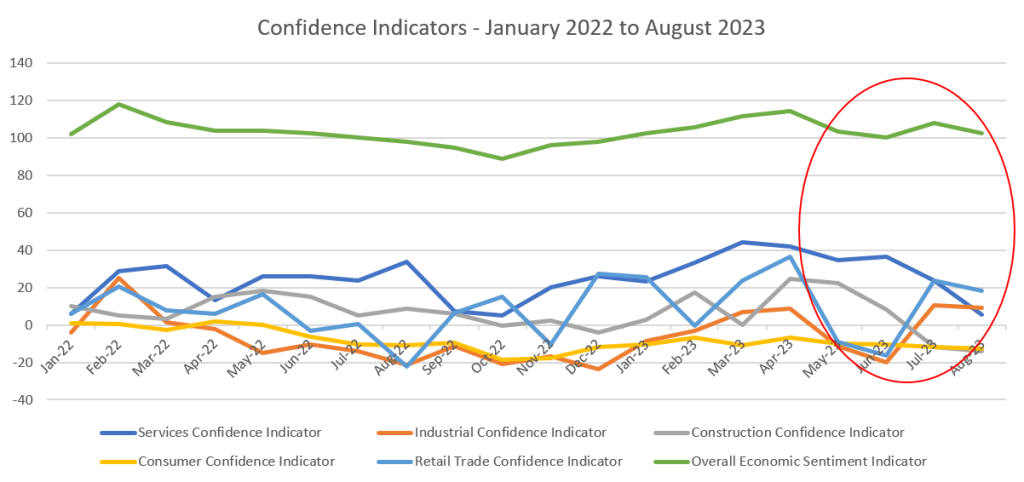
As seen above, in August 2023 the confidence indicator for the services sector fell below its long-term average of 19.6. decreasing to 5.7 from 23.5 in July. This was largely driven by a negative assessment of the business situation over the past three months. Moreover, confidence in the retail sector stood at 18.3, below the 23.5 recorded in the previous month, but still above its long-term average. This decline was due to the fact that retailers’ assessment of sales in recent months and their expectations of business activity over the next three months, stood less positive in the month under review. The confidence indicator for the construction sector edged down to -14.1 in August 2023, from -11.7 a month earlier, falling further below its long-term average of -8.1. The recent decrease in sentiment reflected a deterioration in employment expectations in the construction sector. The consumer confidence indicator remained below its long-term average of -10.2, standing at -12.8 in August, down from -11.8 in the previous month. The fall in consumer confidence sentiment was largely driven by a more negative assessment as well as expectations about their financial situation. Finally, sentiment in industry eased to 9.1, from 10.6 in the previous month, but remained well above its long-term average of -4.2. However, production expectations for the months ahead stood less positive compared with a month earlier.
What does this all mean? Well the writing is on the wall. The sustained high inflation period is eroding confidence and we will likely have to deal with an economic cycle which is less buoyant than what we had until last year. This begs the question – Is your family business or SME ready to deal with and navigate successfully less buoyant market and economic conditions? More specifically can your family business or SME rely on:-
- Constant and timely financial and data reports of key KPIs to constantly monitor how things are evolving and how your business is performing? This is important as the more you manage to increase your margins and reduce costs, you are increasing your business resilience. Thus, analysing data to make your business always more efficient is a constant process.
- An updated business strategy that puts together an analysis of the business environment the business is facing and the how internal resources will be used and administered to achieve strategic goals and targets? This includes a financial plan with some scenario planning to make sure the business has a healthy cashflow to keep operating through a downturn.
- A well oiled corporate governance system that uses the data available to take important strategic decisions in a timely manner? This, first of all, means having a well functioning, skilled and experienced board of directors that oversees the performance of the business, takes strategic decisions accordingly and pushes management to achieve performance targets.
- A strong and well aligned organisational structure that is nimble and flexible enough to quickly adapt and change as market conditions require quick changes to how the business operates and responds to client needs? This also includes whether your staff are skilled in leadership, teamwork and communication, as these are the core skills needed when various changes need to be implemented.
- A plan that outlines how your business can become more environmental sustainable? As recently mentioned, assuming that government will continue subsidising rising energy and fuel costs, is a wrong assumption. How will your business perform if it has to compete with other businesses that have invested in renewables and can thus use energy at a lower cost, when government subsidies are eventually tapered off?
The list goes on and on. With regards family businesses there is also the issue of succession planning, amongst others.
Earlier this year, we at EMCS, have launched a holistic service intended for family businesses & SMEs – the Business Reality Check. Feel free to contact me for a non-committal introductory chat to present to you the Business Reality Check Service and how this can be beneficial for your business to navigate the less buoyant economic times ahead.
 A Business Blog for SMEs & Family Businesses