
Below please find an overview of the salient points with regards the 2024 Budget just presented this evening.
Macroeconomic Overview
- Malta’s economy is expected to grow by 4.1% in real terms by end 2023.
- Inflation in Malta for 2023 is expected to be 5.7%
- In 2024, Malta’s economy is expected to grow by 4.2% (real terms). Domestic Demand is expected to remain strong.
- Inflation in Malta next year is expected to be lower, than in 2023, at 3.7% but higher than the expected Euro area average of 2.8%.
Public Finances
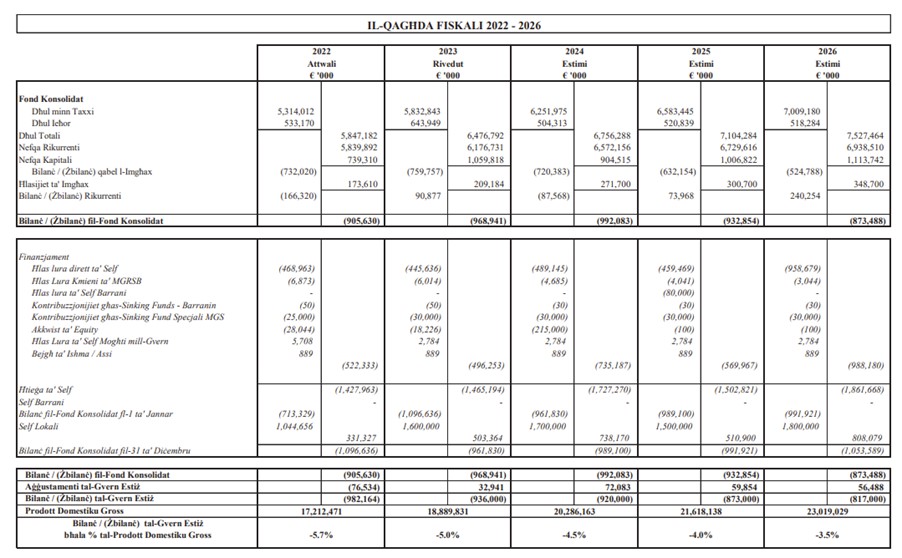
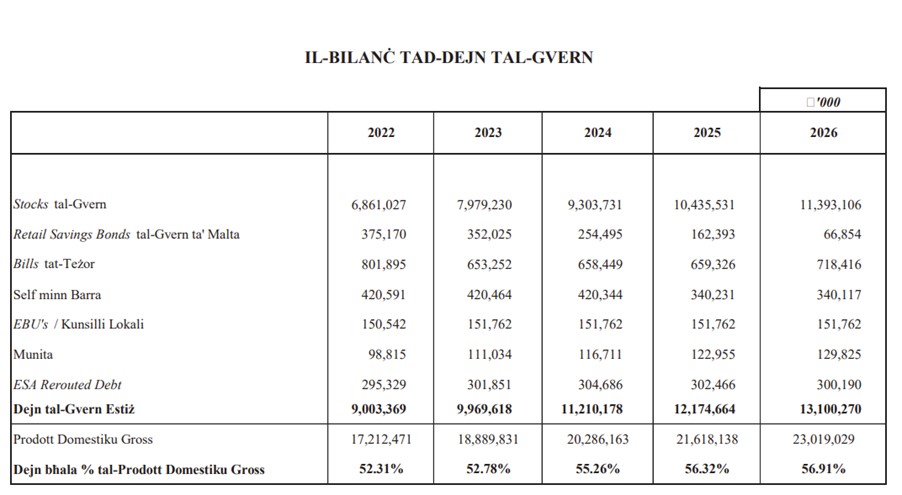
The Public finances are expected to keep having substantial annual deficits for the foreseeable future, with the annual deficit to remain with in the range of around 800 million to 900 million EUR per year. As shown below for the increase in government debt to remain sustainable the economy is forecasted to grow to the level of EUR 23 Billion by 2026, with government debt increasing from under EUR 10 billion by end 2023 to just over EUR 13 billion in 2026.
Overview of Leading Social Measures
- Every pensioner will have see their pension increased by EUR 15 per week or EUR 780 per year.
- A higher increase in pension to be paid to those eligible for a state pension after 61 years of age but keep on working (+6.5% 1 year postponement, +13.5% for 2 year postponement, +21% for a 3 year postponement, +29% for a 4 year postponement)
- Cost of Living Adjustment (COLA) for 2024 shall amount to €12.81 per week
- With effect from January 2024, the minimum wage is to be increased from €192.73 per week to €213.54 per week.The increase in the minimum wage is expected to range from €12 per week to €18 per week up to 2027 (this is over and above the Cost of Living Adjustment).
- Private pensions, Government is asking social partners to conclude discussions on this matter next year.
- Additional measure above COLA is being widened to now have around 95,000 eligible for this. This benefit will vary between EUR 100 – EUR 1,500 per year, per family, depending on the family incomes and number of family members.
- Children Allowance will increase by EUR 250 per child. This will cost EUR 15.5 million.
- Special Allowance when children remain in full time education following obligatory education of €500 per annum for the next years, if they remain living with their families
- The benenfit for every new born or new adoption is being increased from EUR 400 to EUR 500 for the first born and from EUR 400 to EUR 1,000 for the second born.
- Benefit for the elderly of 80 years and over, who live at home or in a private home will increase by EUR 50 to EUR 450 per year, while those between 75 years to 80 years will remain receiving the EUR 300 per year.
- The subsidy “Carer at home” for the elderly will be increase by EUR 1,000 to EUR 8,000 per year.
- Increase in unemployment benefit to hit 60% of last wage for the first six weeks and than tapers to 55% for the next 10 weeks and 50% for another 10 weeks.
- Increase in tax credits for disabled children under therapy, not offered by Government from EUR 200 to EUR 500 per year.
- Persons undergoing a rehabilitation programme will see the assistance they receive from EUR 10 per week to EUR 50 per week.
Investing in Skills
- The general tax refund scheme will remain as last year, with refunds between EUR 60 to EUR 140 per person to be paid, depending on level of income,but below an annual income of EUR 60,000
- Pensioners who keep on working, will see a greater chunk of their pension not considered as taxable income. This chunk has now been increased to 60%.
- Student stipends will continue increasing pro-rata with the cost of living, resulting in a EUR 64 per year.
- Get Qualified Tax credits for those studying at Masters or Doctorate level will continue.
- Whilst Malta has economic sectors which need foreign workers, government will implement systems whereby only foreign workers that are truly needed will be allowed to come to work in Malta, whilst improving the skills of such foreign workers.
Future Economy
- Venture Capital Fund has been introduced and next year a new Seed investment Scheme will be introduced. This scheme will offer tax credits to Maltese companies that invest in start-ups.
- Skills Development Schemes , Rent Subsidy Schemes, Smart & Sustainable Scheme will be continued
- ESG consultancy schemes for SME, recently launched will continue into 2024
- Mala a centre for microchips, as an approved EU member state to fall under the IPCEI, through ST Microelectronics
- International Taxation: The EU Directive that implements a minimum global tax will come into effect in 2024. However this directive allows for Member States not to apply for a maximum of 6 years, in the case where such member state does not have a lot of big Multinational companies. Malta will therefore not include any tax top up to fit 15%, to allow for Malta to follow global developments and be prepared to act accordingly.
- Family Businesses: Besides the usual reduction of stamp duty when they do intervivos transfers from 5% to 1.5%, this budget will see that Family Businesses, registered with the Family Business Office will have a greater capping for tax credits related with investments. Family Businesses will also be supported with tax incentives when they go international, digitalise or innovate.
- The Government aims to launch a consultation concerning tax incentives that are tailored to Real Estate Investment Trusts (REITs).
- The Government is to explore the introduction of an ad hoc tax depreciation framework and initiatives to attract banks and financiers in support of the aircraft leasing sector.
- The Malta Financial Services Authority (MFSA) is in the process of implementing regulatory changes, including those relating to Notified Professional Funds and Limited Partnerships.
- Government has committed to focusing on the implementation of the national e-sports strategy and shall also continue strengthening the quality of education and training for the development of digital games.
- The Malta Gaming Authority shall focus on strengthening the regulatory framework to ensure that it remains relevant to meet the challenges of the gaming industry.
- During 2024, Government aims to design Malta’s vision for the maritime industry for the next 20 years as well as implement a new aviation policy together with the Air Navigation Act.
- A new consultation will be held to discuss new proposals for tax incentives for sustainable investments, like Green bonds.
- The Business Enhance, EU funding, will continue next year. These schemes will give SMEs around EUR 40 million in cash grants. Such Schemes will focus on Start-ups, the growth of such SMEs, the diversification of such SMEs and SMEs that invest to reach new markets.
- In the coming months a new scheme from Lands Department, similar to the 2015 Valletta Shop Scheme, will be launched for the whole national territory.
Environment
- A Climate Action Authority will be set up with the aim of spearheading Malta’s commitment to reach climate neutrality by 2050.
- Government plans to initiate work on a strategy to introduce the use of hydrogen locally.
- Government plans to launch a consultation for the development of fiscal incentives for companies and investors to make sustainable investments.
- Renewable energy schemes on solar panels, batteries for energy conservation and heat pump water heaters, will be continued.
- A new scheme will be introduced to incentivise the purchase of personal e-kick scooters.
- Electric vehicles, as well as plug-in hybrid vehicles, with an electric range of not less than 50km will remain exempt from the payment of registration tax in 2024, as well as from the annual circulation tax for five years from the date of registration.
- There will be an allocation for 40kWp and 1MWp to reach 10MWp, which will mean an assistance of EUR 44.8 million over 20 years. If this allocation is taken all this will mean an energy generation from renewables for the need of around 3,650 households.
- The scheme for home reverse osmosis systems will continue in 2024.
- The schemes with regards the purchase of new electric cars and motorcycles will be continued.
- With regards traffic, a study will be undertaken next year on the possibility of a public-private partnership, for parking zones.
 A Business Blog for SMEs & Family Businesses