

A recent research article my McKinsey outlined a number of critical mindsets and strategic actions that are the fundamentals which allow family businesses not only to succeed but to also outperform other non-family businesses. The article is some 15 pages long and knowing how everyone is time pressed I am providing a summary below.
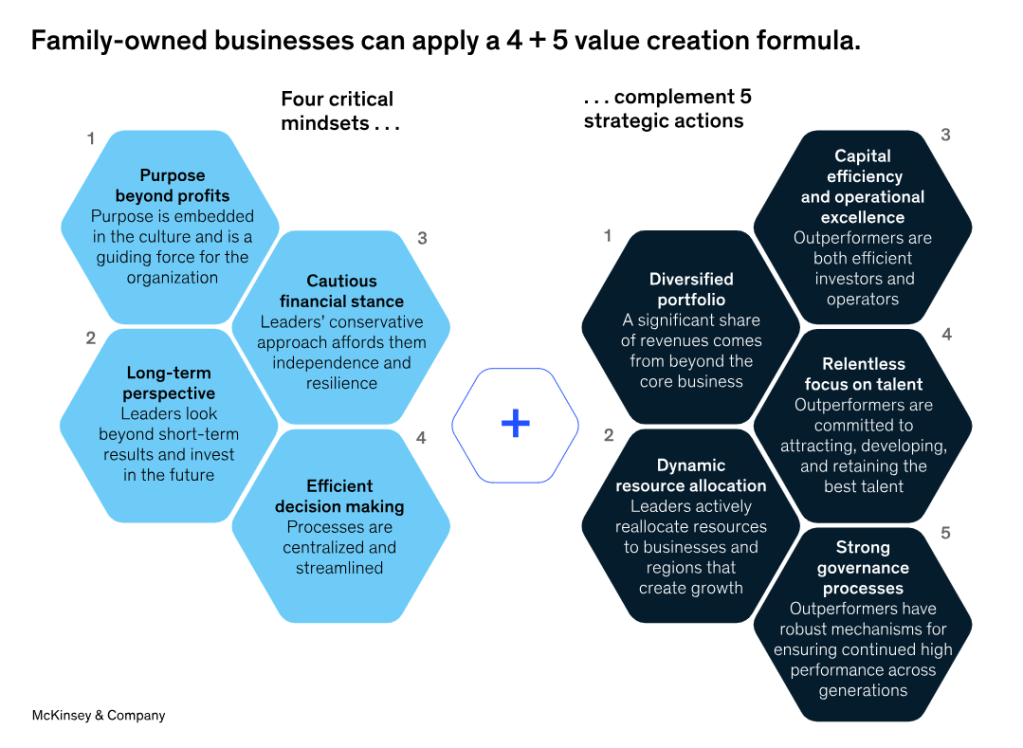
The article explains that research outlines four critical mindsets for family businesses that succeed. These are:-
- They focus on purpose beyond profits: Research shows that almost all family businesses that succeed have a clear purpose beyond creating value for shareholders. This sense of purpose can take many forms. It can be inward looking and focused on building the company’s legacy—for instance, by maintaining a strong reputation, protecting the brand image, or nurturing a strong company culture. Or it can be outward facing, focused on maximising value for customers or generating positive impact to society at large. This purpose-driven mindset is also reflected in the family business approach to hiring, promotion and retention. Loyalty is a key value in most of these companies and leaders reveal an ability to look “through the cycle” and avoid layoffs in crisis periods.
- They take a long-term perspective and reinvest in the business: Successful family businesses indicate that their long-term perspective is one of the top three reasons for their success, alongside the ability to innovate and to expand into new markets and regions. They ruthlessly optimise for the longevity and resilience of the organisation, even if it comes at the expense of short-term performance. They work to strategically diversify and in their operations to eliminate single point of failures. Research also indicated that successful family businesses also tend to reinvest in the business rather than extract as much as they can from the company through dividends. They are not under the same pressures that non-family business are increasingly under to prioritise higher dividends to meet shareholder expectations, which helps them outperform non-family businesses in the longer term.
- They are financially conservative and cautious about debt and high-risk investments: Research outlines that in general, family businesses tend to be financially cautious, with leverage ratios that are, on average, much lower than non-family businesses. This cautious approach to finances helps family businesses weather significant economic shocks such as the recent COVID-19-triggered downturn and emerge in better shape.
- Internal processes that allow for efficient decision making: Research also indicates that greater efficiency in decision making is key to success. This is normally possible due to two factors: Centralised but flexible processes and engaged employees. When family members disagree, well structured family business can take advantage of their flexible structures and processes to consider all the different points of view. They understand that decision making can be both quick and deliberate—and that the ability to adjust as needed is a true differentiator in performance. On the other hand, engaged employees enable a quicker implementation of any changes.
Research from McKinsey, indicated that the best Family Businesses that combine the above four critical mindsets with the below five strategic actions, manage to have their business performance and longevity set them apart from the rest. The strategic options are outlined below:
- They actively diversify their portfolios: The research clearly indicates that highly diversified family businesses outperform the rest. portfolios. Outperforming family-owned businesses have substantial share of revenues that come from beyond their core businesses.
- They dynamically reallocate resources: Family businesses, with a growth and strategic mindset and not always bogged down in operations, tend to outperform other businesses as they are able to aggressively and dynamically allocate their resources toward businesses or channels they believe will drive the most growth.
- They are efficient investors and operators: Besides allocating resources efficiently, as mentioned above, the best family businesses focus on always achieving more efficient operations as they grow and scale up. The bottom line is simple – the best family businesses are efficient at both investing and operations. To achieve this, data is key. The best family businesses use a broad set of data to evaluate organisational performance. For instance, the best of breed family businesses use key performance indicators (KPIs) to measure executive performance, including top- and bottom-line figures and valuation metrics.
- They maintain a relentless focus on attracting, developing and retaining talent: Talent management is an obsession for the best performing family businesses
- They continually review their governance mechanisms to ensure strong corporate performance across generations: The best performing family businesses take the separation of family and business matters very seriously, thus having formal documentation in their companies with clear guidelines on the roles and responsibilities of family members and with an effective and independent board of directors in place and a formal forum that meets regularly to discuss family and business issues. Best performing family businesses ensure that before family members reach any top position they spend time in different parts of the company to develop a sense of ownership and connection to the company culture, deepen their understanding of processes, develop their management skills, and most importantly, earn the trust and respect of the broader organisation. Another aspect of successful family businesses is for them to look outside blood lines for leadership. Research has shown that professional management, when well identified and given the right conditions to prosper, can produce better results than family-only structures.
The above outlined four critical mindsets and five strategic actions outlined by McKinsey, all form part of the Award in Leading a Family Business accredited course. The 2nd cohort will now start in February 2024. Click HERE to REGISTER.
 A Business Blog for SMEs & Family Businesses