
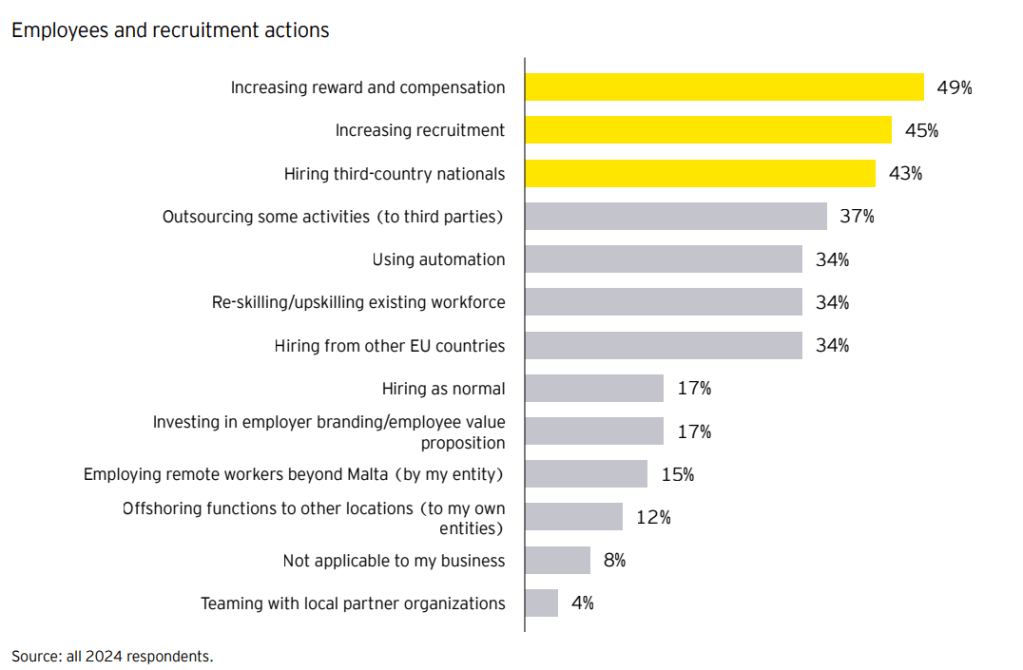
One of the things that impressed me from EY’s attractiveness survey from 2024 was the following. The below shows that the top 3 reactions of FDI companies in Malta to make up for the tight labour market, was increasing wages, recruiting more people and recruiting third country nationals. I believe such response is because most businesses suffer from the so called ‘strategic myopia’.
Most businesses operate with the mindset that “polishing yesterday’s way of work” will be enough. However in a world in constant flux, it just isn’t. This means focus on improving the efficiency within the confines of “how we normally do things around here” will inevitably miss the opportunity to develop a new strategy in response to new conditions. This is what ‘strategic myopia” is all about.
It is far easier to prioritise the urgent, the proven and the easily measured , rather than embracing other possibilities. In part this myopia comes from what we expect from a new strategy. Strategy is not a plan. A plan might come with a guarantee: “If we do this, we will solve the issue.” A strategy, on the other hand, comes with the risk of things not working. Strategy is a philosophy of becoming, a chance to create the conditions to enable the change we seek to make in our businesses, our economy and the world.
When business leaders demands a strategy that comes with certainty of success, the business will likely settle for a collection of short-term tasks, tactics and quick fixes. To do strategy right, we need to lean into possibility.
It’s easy to get stuck in strategy myopia and to avoid this, I believe successful business leaders need to follow these principles:
- Not all is about short-term, immediate results: New projects solving future problems are always less efficient than the status quo. Business leaders often prefer concrete quick fixes that are easy to measure and simple to compare, whilst a useful strategy almost always begins as both inconvenient and inefficient. Strategy is based on the insight that what’s challenging now will get easier over time. So it is far easier to fix staffing problems by employing Third Country Nationals, rather that revising operational processes to make them more efficient and investing in new systems that would enable doing more with less people. But businesses cannot keep doing this indefinitely.
- Choose your Purpose and Customers: Strategic myopia occurs when business fail to identify who we seek to serve and why we seek to serve them. Instead businesses focus on what they seek to produce instead. A tactical, short-term focus is based on the past. Many businesses try to defend the investments done and processes already in place, working to maximise output within these strict confines. Instead, businesses should visualise their customer and serve their needs as the world changes.
- Choose your Culture & Team: Not everyone is cut out to be strategic. Many are focused on the past and defending the status quo. So it is not advisable to start the journey of setting a new strategy by having all the leadership or managers in a business involved. Many successful strategies kick off from
tiny teams and insightful individuals. People who are skilled in practical empathy, eager to identify and amplify the needs of the customers the business seeks to serve. People who have demonstrated domain skills in what can be done, with a particular focus on folks who accomplish things that others say are impossible. Individuals with a passion for game theory and scenario planning. Successful project managers. If strategy is a philosophy of becoming, you will need people eager to build something that’s not there yet.
- Keep asking interesting questions, take nothing for granted: To avoid strategic myopia, business leaders should begin by looking for problems within their business. Some business leaders actually prefer to keep shoving these problems under the carpet. Problems demand solutions, and solutions become projects, and then, eventually, projects become industries. Which is why good business leaders are those that are change agents, rather than defending the status quo. Systems are often invisible, hiding behind culture. Systems occur when humans need interoperability, a chance to trade or transact or connect. System minded people fight to remain the same, but when technology or communication shifts, a change agent is needed.
In my daily interactions with businesses, I still see that business leaders spend way too little time (if any at all) working on and discussing the organisation’s strategy. The likely reason: It’s easier to focus on short-term plans, quick fixes and immediate performance instead. Strategy feels illusive, while there’s “real work” to be done right now. But as many other strategy experts have warned over the years, if you’re going in the wrong direction, it doesn’t matter how fast you’re going. Work on strategy today.
 A Business Blog for SMEs & Family Businesses