In recent years Malta has been getting some 20,000 foreign workers annually. It is now becoming evident that this is unsustainable. The Prime Minister last Sunday spoke about the upcoming new labour migration policy and was quoted as saying that “We are going to undertake a study that is calibrated to the needs of our people. We will only accept the foreign workers who are truly needed. Those who are needed can come, but those who are not needed will not get in”. In a nutshell, it seems obvious that the days of a more lax approach to get any type of foreign worker in Malta, is well behind us. This also means that businesses that have “thrown” workers (mostly foreign workers) to man inefficient systems, will need to re-think their operating model.
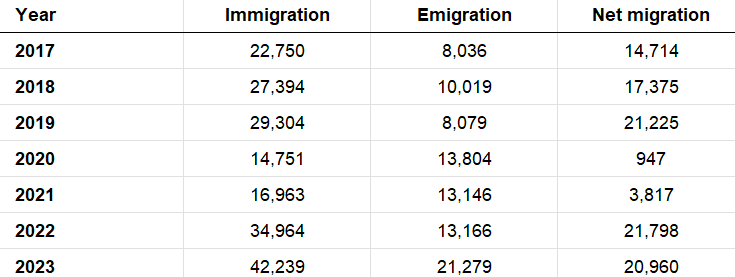
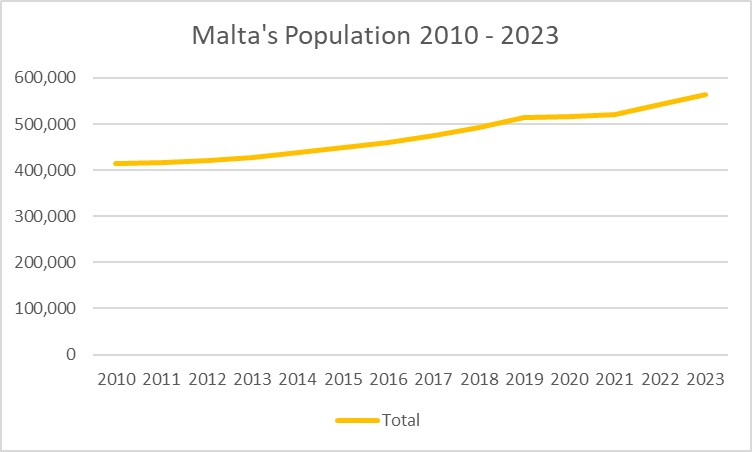
Let us re-wind the tape a bit. The below figures that from 2017 to 2023 (bar 2020 & 2021), we had an average annual immigration coming to Malta of around 19.4K persons. This also means (as per graph shown below) that Malta resident population between 2010 to 2023 gew by over 148K persons or by 35.7%. Obviously all this has left a huge strain on Malta’s infrastructure at all levels, be it traffic, health services, electricity distribution and drainage.
In my experience of dealing with various family businesses, it is unfortunately a too common occurrence that inefficient systems are used, many times because that is “how things where always done here”. Moreover, getting people from across the globe to keep such inefficient systems was an ‘easy’ solution. It is now obvious that things will change. Hence why I strongly advocate each family business to consider the following:-
- Document each and every process that is used to make things happen in your business. Then map out such processes together. You will be surprised as how much will be discovered. You will very likely realise the massive single point of failures, duplications and time wastage your present systems have. This is so, because your present way of doing things has evolved over time with bits added here and there over time, which makes the whole thing seems like something from coming out from the 12 tasks of Asterix.
- With the documentation of processes in hand, you can now really start understanding how to best start optimising your processes and further digitalise operations to enhance efficiency and fostering lean operations.
- All this will ultimately lead to see how to best optimise your present software and ERP systems to the new more efficient processes. As part of this exercise you could realise that you would need to change your present ERP system. You need to be careful to choose the right ERP system that really meets your needs as outlined in the whole process documentation and analysis exercise undergone. Ultimately, choosing the right system for your company can significantly impact your success.
I strongly advise family businesses to give huge priority to all of the above. I do not want to sound pessimistic, however it is very likely that Malta’s labour market is going to become even tighter. Thus, it is going to become imperative for businesses to be more efficient in their operations and to do more with less people. This will likely be one of the key determining factors between successfully and less successful businesses.
At EMCS we can help you undergo a process documentation and optimisation exercise and we also can help you gain funding for this.
 A Business Blog for SMEs & Family Businesses