

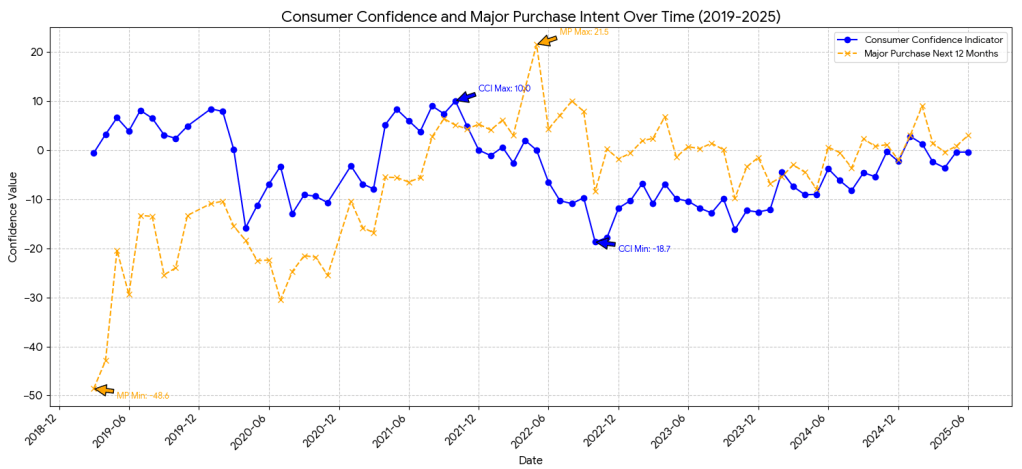
The attached is a graph of the Consumer Confidence Indicator (CCI) in Malta from end 2018 to June 2025 and the Major Purchases over the next 12 months (MP12M) indicator over the same period, as published by the Central Bank of Malta in its Economic Updates. . The above gives us a lot of data to produce the below detailed analysis of the consumer confidence data, including the trend on making major purchases in the next 12 months.
Consumer Confidence Indicator (CCI): This indicator reflects the general sentiment of consumers regarding the economy and their financial situation and the trend over the mentioned period give us the below insights:-
- Fluctuating Confidence: The CCI has experienced significant fluctuations over the period, ranging from a high of 10.0 on October 1, 2021, to a low of -18.7 on October 1, 2022. The average confidence value over this period is -3.8.
- Pre-Pandemic Stability (Early 2019 – Early 2020): The CCI started near neutral and showed some positive movement before the major global events of 2020.
- Significant Drop During COVID-19 (Spring 2020): A sharp decline to -15.8 in April 2020 is highly likely attributable to the onset of the COVID-19 pandemic.
- Gradual Recovery and Peak (Late 2020 – Late 2021): The CCI showed a gradual recovery, reaching its peak of 10.0 in October 2021, reflecting increasing vaccination rates and easing restrictions.
- Decline and Lowest Point (Late 2021 – Late 2022): After the peak, the indicator began a significant downward trend, reaching its lowest point of -18.7 in October 2022, likely due to rising inflation and geopolitical events.
- Partial Recovery and Volatility (2023 – Mid-2025): From the end of 2022 into 2023, there was a modest recovery, though confidence levels remained in negative territory. As of June 2025, the indicator is at -0.4, showing slight improvement compared to the latter half of 2024.
Major Purchase Next 12 Months (MP12M): This indicator reflects consumers’ willingness and confidence in making significant purchases in the near future, such as cars, homes, or large appliances and this indicator gives us the below insights:-
- Highly Volatile: This indicator shows even greater volatility than the overall Consumer Confidence Indicator, with values ranging from a high of 21.5 on May 1, 2022, to a low of -48.6 on March 1, 2019. The average value is -6.0.
- Pre-Pandemic Pessimism (Early 2019): Interestingly, the MP12M indicator started at a very low point (-48.6 in March 2019), suggesting significant hesitation towards major purchases even before the pandemic. It then showed some recovery into 2020.
- COVID-19 Impact (Spring 2020): While not as sharp a single drop as the CCI, the MP12M indicator remained deeply negative during the initial phase of the pandemic (e.g., -18.4 in April 2020, -22.5 in May 2020), reflecting economic uncertainty.
- Delayed Recovery and Strong Rebound (Late 2020 – Mid-2022): Unlike the CCI which peaked in late 2021, the MP12M indicator showed a more sustained and significant recovery into 2022, reaching its peak of 21.5 in May 2022. This strong rebound in purchase intentions could be attributed to pent-up demand, increased savings during lockdowns, and a sense of returning normalcy, even as overall confidence started to waver due to inflation.
- Subsequent Decline (Mid-2022 – Late 2023): After its peak in mid-2022, the MP12M indicator saw a sharp decline, falling into negative territory and hitting -9.8 in October 2023. This mirrors the decline in overall consumer confidence and likely reflects the impact of high inflation, rising interest rates, and broader economic concerns on big-ticket spending.
- Recent Stabilisation and Slight Recovery (2024 – Mid-2025): Since late 2023, the MP12M indicator has shown some signs of stabilisation, hovering around neutral to slightly negative values. As of June 2025, it stands at 3.0, indicating a modest renewed willingness among consumers to consider major purchases, despite the overall CCI remaining cautious.
What is the relationship between the two indicators?
While both indicators plummeted during the initial phase of the pandemic, their recovery trajectories diverged. The Major Purchase indicator peaked later (May 2022) and reached a significantly higher positive value (21.5) than the overall Consumer Confidence Indicator (10.0 in Oct 2021). This suggests that while consumers might have generally felt less confident about the broader economy (CCI), their personal financial situations might have allowed for, or even encouraged, major purchases for a period, perhaps driven by low interest rates or accumulated savings.
Both indicators show a strong correlation during their declines from late 2021/mid-2022 onwards, indicating that widespread economic concerns like inflation and interest rate hikes negatively impacted both general sentiment and specific purchase intentions.
In the most recent period (2024-2025), the Major Purchase indicator has shown slightly more resilience and positive movement compared to the overall Consumer Confidence Indicator, which remains largely in negative territory. This could suggest that while consumers are still cautious overall, a segment might be feeling more financially secure or find current market conditions more favourable for specific large investments.
In conclusion, the data illustrates how consumer sentiment, while generally aligning between overall confidence and purchase intent, can also diverge based on specific economic conditions, such as the timing of economic recovery, inflationary pressures, and interest rate environments. The recent slight uptick in major purchase intent, despite lingering cautious overall confidence, is a notable development.
 A Business Blog for SMEs & Family Businesses