
I would be a much richer man had I collected at least 10 Euros each time a family business owner said this to me – that management is just common sense. This statement, often uttered by business owners, particularly those with a background rooted in operations, reveals a fundamental misunderstanding of what management truly entails. It’s a perspective born from an operator’s mindset—a focus on the tangible, the immediate, and the technical aspects of a job, rather than the intricate, human-centric and strategic demands of leading an organisation.
While an operator’s mindset is invaluable for the day-to-day execution of tasks, applying it to management is a recipe for mediocrity, if not outright failure. It’s a view that simplifies a complex discipline into a series of intuitive actions, overlooking the vast body of knowledge, skill, and expertise required to navigate a competitive landscape. When you peel back the layers and investigate businesses where this philosophy reigns supreme, a myriad of shortcomings often comes to light.
One of the most glaring shortcomings is a lack of strategic planning. The “common sense” approach often prioritises immediate fire-fighting over long-term vision. Decisions are made reactively, not proactively, and the business drifts without a clear destination. There’s no formalised strategic plan, no defined goals beyond short-term revenue, and no understanding of market shifts or competitive threats. This reactive stance leaves the company vulnerable and unable to capitalise on opportunities. The “common sense” manager operates in a state of perpetual reaction. They’re so busy bailing water out of the boat they never notice they’re a mile from the dock and heading for a waterfall. Their strategy is simply to survive the day.
Another critical deficiency is the absence of effective human resource management. If management is just common sense, then employee relations are often handled informally and inconsistently. There’s little to no investment in professional development, training, or succession planning. Performance evaluations are often subjective and infrequent. This environment fosters low morale, high employee turnover, and a culture where talent is not nurtured but instead is expected to fend for itself. The business loses its most valuable asset—its people—to companies that understand the science and art of building and retaining a high-performing team. This approach treats human resources as a magical process: “We’ll just employ good people, and they’ll be good.” There’s no professional development, no consistent performance reviews, and often, an unspoken rule that if you’re not working 24/7, you’re not dedicated. The result is a revolving door of employees who burn out and leave, taking their institutional knowledge with them.
Furthermore, these businesses often struggle with poor organisational structure and process management. An operator’s focus on the individual task means the broader system is often ignored. Roles and responsibilities are unclear, leading to duplication of effort and internal conflicts. There are no standardised processes or quality control measures, which results in inconsistent outputs and customer dissatisfaction. The business operates like a collection of individuals rather than a cohesive, efficient machine, making it impossible to scale effectively. Instead of a clear organisational structure, these businesses often have a tangled web of responsibilities. People trip over each other’s work, and processes are invented on the fly, leading to inconsistent quality and wasted time. This “common sense” family often has more drama than an actual family dinner, and it’s just as chaotic.
Finally, the “common sense” philosophy overlooks the importance of data-driven decision-making and financial acumen. Gut feelings and anecdotal evidence take precedence over data analytics. There is a lack of sophisticated financial planning, budgeting, and performance tracking. Without a deep understanding of key metrics, the business owner is flying blind, unable to identify areas of profitability, manage costs effectively, or make informed decisions about future investments.Data and metrics are dismissed in favor of “instinct.” Financials are a mystery, and decisions are based on what “feels right” rather than what the numbers say. The business is a car with a broken dashboard, and the owner insists they can drive perfectly fine by just listening to the engine.
The truth is, management isn’t common sense—it’s a learned discipline. And a great tool for understanding this is the Eisenhower Matrix. This simple framework categorizes tasks based on two criteria: urgency and importance.
Here is an image of the matrix to better illustrate its quadrants.
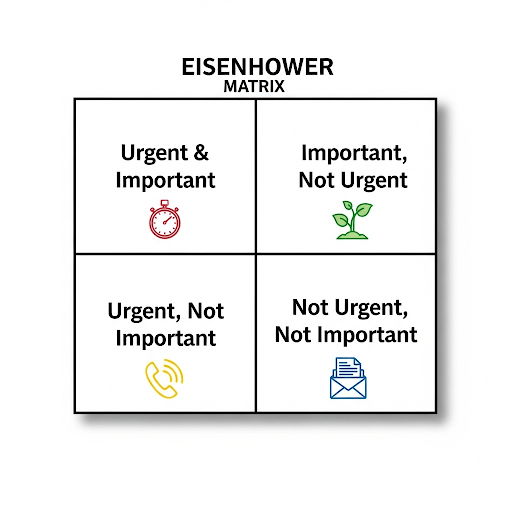
Quadrant 1: Urgent and Important. This is the “Crisis” quadrant. Tasks here are time-sensitive and have a high impact, like putting out a production fire or dealing with an angry client. These are the tasks that make “common sense” managers feel productive, but they’re often a symptom of poor planning. These managers spend their entire lives here, running from crisis to crisis, fueled by panic-induced calls and late-night texts.
Quadrant 2: Important but Not Urgent. This is the “Planning” quadrant. Tasks here are crucial for long-term success but don’t have an immediate deadline. This is where strategic planning, team development, and process improvement live. This quadrant is a “common sense” manager’s worst nightmare, because it requires them to sit down, think ahead and be proactive.
Management is not a matter of common sense; it is a specialised discipline that requires continuous learning, strategic thinking, emotional intelligence and a deep understanding of people, processes, and markets. It is the deliberate application of skills and knowledge to align resources and achieve organisational goals. While an operator’s passion and practical knowledge are the engine of a business, it is the sophisticated hand of a skilled manager that steers the ship toward success, navigating the complex waters of the modern business world with foresight, precision and most of all… purpose.
 A Business Blog for SMEs & Family Businesses