
Below please find a detailed overview of the 2026 Budget:
1. Macroeconomic Overview
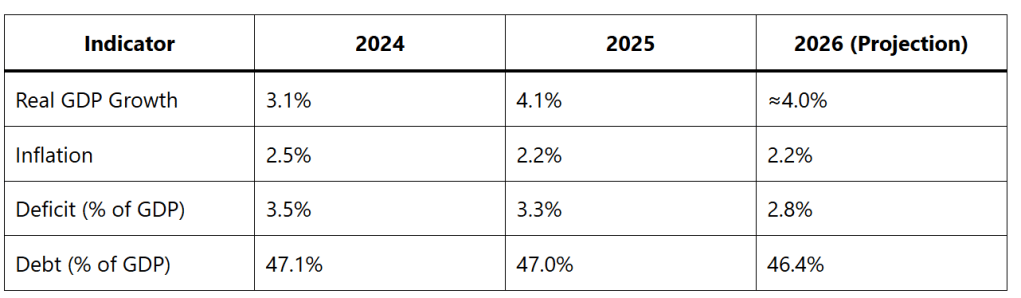
Government Finance:
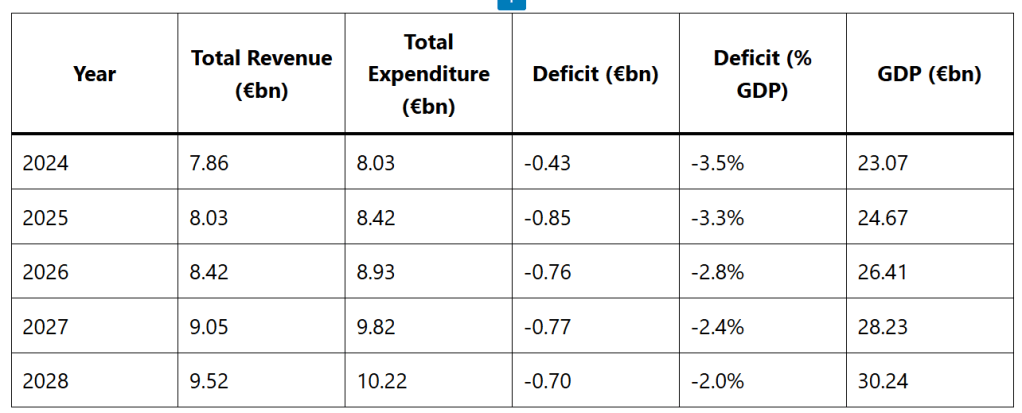
Fiscal Projections:
Government Debt Stock (€ ‘000)
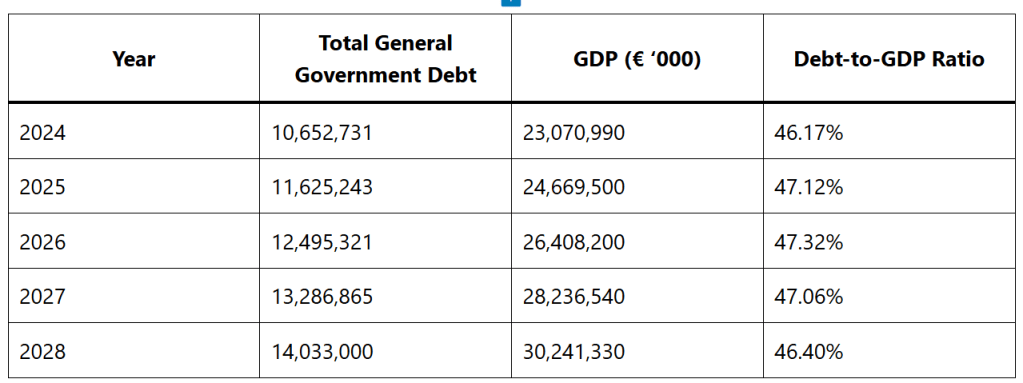
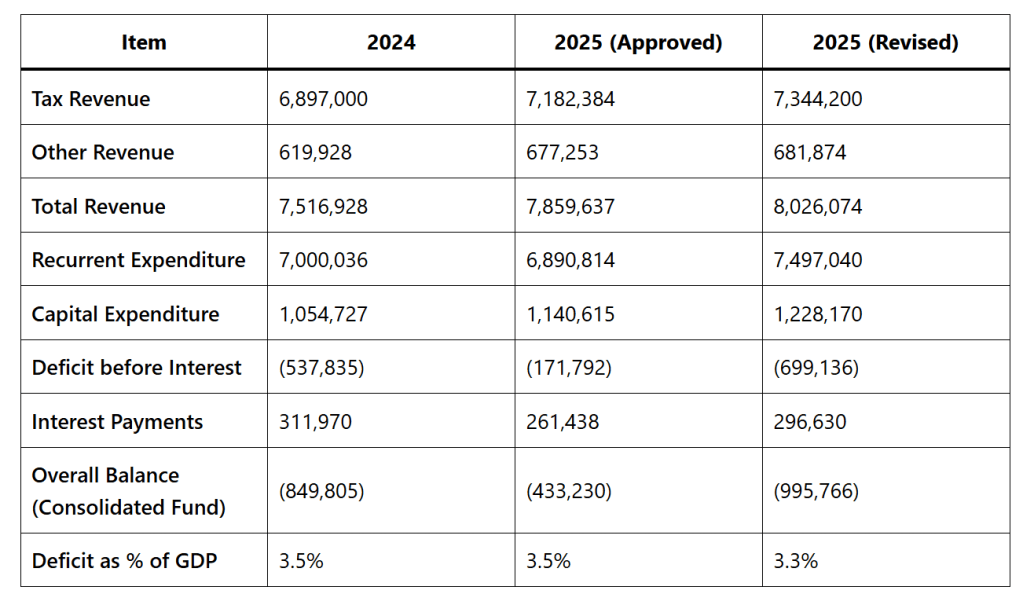
The above shows that when comparing 2024 to 2025, Government total revenue is expected to grow from €7.52 billion (2024) to €8.03 billion (2025 revised), an annual increase of roughly 6.8 %, outpacing nominal GDP growth. On the other hand recurrent expenditure rises from €7.00 billion to €7.50 billion from 2024 to 2025. (≈ 7 % growth). Capital spending climbs by about 16 %, reflecting ongoing EU-co-funded projects in infrastructure and environmental adaptation.
With regards fiscal projections, the GDP-to-deficit is forecasted to declines steadily from -3.5 % (2024) to -2.0 % (2028), achieved through revenue buoyancy rather than expenditure cuts. However government forecasts to keep running annual deficits in the region of Eur 800m – EUR 700m in the foreseeable future, meaning that government is forecasting to hit a total Debt level of EUR 14Bn by 2028. The total public debt-to-GDP ratio is is to remain in the region of 46% – 47% as GDP is forecasted to grow from the level of EUR 24.7Bn in 2025 to EUR 30Bn by 2028.
2. Families, Taxation & Social Measures
Family Income-Tax Reform (2026-2028): The new reform reduces the tax burden for families with dependent children through updated tax-free thresholds and modified income bands under the Maltese tax computation system. It applies to both Married Couples Computation (Komputazzjoni Miżżewġin) and Parent Computation (Komputazzjoni Ġenitur).
Families qualify as long as their youngest child is under 18 years old, or under 23 if still in full-time education. Two distinct schedules apply:
- Families with one child, and
- Families with two or more children.
The Total cost to government: €160 million across three years, with Beneficiaries: of about 68,000 parents initially, with average tax savings around around €2,400 per family (over 3 years).
Married Couples – One Child
Under the Komputazzjoni Miżżewġin b’Wild Wieħed, tax-free income thresholds rise progressively from €15,000 to €22,500 by 2028.
| Year | Tax-Free Threshold (€) | Top Marginal Rate | Maximum Annual Saving (€) |
|---|---|---|---|
| 2026 | 17,500 | 35% | 725 |
| 2027 | 20,000 | 35% | 1,450 |
| 2028 | 22,500 | 35% | 2,175 |
2026 Rate Table – Married with One Child
| Income Band (€) | Rate | Deduct (€) |
|---|---|---|
| 0 – 17,500 | 0% | 0 |
| 17,501 – 26,500 | 15% | 2,625 |
| 26,501 – 60,000 | 25% | 5,275 |
| 60,001+ | 35% | 11,275 |
Roughly 2,400 families benefit under this category, with an average final-year tax saving of €1,575.
Parent Computation – One Child
Applies where both parents work. The tax-free threshold rises from €13,000 to €18,000 by 2028.
| Year | Threshold (€) | Max Annual Saving per Parent (€) |
|---|---|---|
| 2026 | 14,500 | 570 |
| 2027 | 16,000 | 1,150 |
| 2028 | 18,000 | 1,800 |
2026 Rate Table – Parent with One Child
| Income Band (€) | Rate | Deduct (€) |
|---|---|---|
| 0 – 14,500 | 0% | 0 |
| 14,501 – 21,000 | 15% | 2,175 |
| 21,001 – 60,000 | 25% | 4,275 |
| 60,001+ | 35% | 10,270 |
An estimated 23,750 parents benefit, with joint household tax savings of around €3,600 annually by 2028.
Married Couples – Two or More Children
This category yields the strongest tax relief, acknowledging the higher cost of child-rearing in multi-child households.
| Year | Tax-Free Threshold (€) | Maximum Saving (€) |
|---|---|---|
| 2026 | 22,500 | 2,025 |
| 2027 | 30,000 | 4,050 |
| 2028 | 37,000 | 6,000 |
2026 Rate Table – Married with Two or More Children
| Income Band (€) | Rate | Deduct (€) |
|---|---|---|
| 0 – 22,500 | 0% | 0 |
| 22,501 – 32,000 | 15% | 3,375 |
| 32,001 – 60,000 | 25% | 6,575 |
| 60,001+ | 35% | 12,575 |
Approx. 5,000 families benefit, with a typical tax reduction of €3,500 by the third year.
Parent Computation – Two or More Children
For two working parents with two or more children, the Komputazzjoni Ġenitur b’Żewġ Ulied jew Aktar offers the most generous incentives.
By 2028, a dual-earner couple each earning €30,000 annually will pay no income tax at all.
| Year | Tax-Free Threshold (€) | Maximum Saving per Parent (€) |
|---|---|---|
| 2026 | 18,500 | 1,625 |
| 2027 | 24,000 | 3,250 |
| 2028 | 30,000 | 5,000 |
2026 Rate Table – Parent with Two or More Children
| Income Band (€) | Rate | Deduct (€) |
|---|---|---|
| 0 – 18,500 | 0% | 0 |
| 18,501 – 25,500 | 15% | 2,775 |
| 25,501 – 60,000 | 25% | 5,325 |
| 60,001+ | 35% | 11,325 |
Total beneficiaries: ~29,300 parents, with an average end-period annual tax saving of €3,500 per parent, equating to €10,000 in total per household by 2028.
Broader Social and Family Measures
Budget 2026 introduces a broad set of income support and social policy initiatives, totalling around €120 million in new spending. These include:-
- €10 weekly pension increase for over 100,000 pensioners (retirement, invalidity, and widow categories).
- Additional €3.50 weekly for 7,000 widows.
- €10 weekly rise for 1,000 widowed single parents (now payable until the child turns 23).
- Allowance Supplement: raised to €27.30/week (couples) and €14.40/week (singles).
- Income thresholds increased to €20,000 and €14,000 respectively.
- Annual Supplement for over-65s: increased by €100 to €250, now payable to both spouses.
- COLA Bonus Standardisation: From 2027, all pensioners to receive a uniform €21.53 weekly rate, eliminating legacy discrepancies.
- Adjusted Minimum Pension Rates: +€2–€14 weekly for 5,000 pensioners to harmonise benefit rates.
- Service Pension Adjustment: +€200 per annum (new rate €3,866), benefiting ~7,000.
- Non-contributory Pension Bonus: raised to between €600 and €1,050.
- Elderly Living Allowance: +€75; now €425 (ages 75–79) and €525 (ages 80+).
- Sick Benefit & Severe Illness Benefit:
- Married rate: €34.42/day (severe illness)
- Single rate: €25.81/day (severe illness)
- Standard sickness benefit: €25.81/day (married), €17.21/day (single).
Disability benefits will be improved as shown below:-
| Benefit Type | Weekly Increase (€) | New Weekly Rate (€) |
|---|---|---|
| Enhanced Severe Disability Assistance | +6.89 | 206.50 |
| Severe Disability Assistance | +4.66 | 134.56 |
| Disability Assistance | +4.66 | 107.28 |
| Visual Impairment Assistance | +4.66 | 134.56 |
| Enhanced Carer’s Allowance | +4.66 | 183.68 |
| Carer’s Allowance | +4.66 | 130.58 |
- Carers’ Grant: raised from €5,189.65 to €5,368.89/year.
- Therapy Refund for Children with Disabilities: +€250 (new cap €1,000/year), extended eligibility up to 23 years.
- Increased In-Work Benefit: +€75 per child as part of a commitment to raise the benefit by €200 per child during this legislature.
Children’s Allowance:
- Income threshold for higher rates increased to €30,000.
- Families earning below this level gain an extra €250 per child, plus up to €167 for the lowest-income households.
- Over four years, increases total between €590 and €1,007 per child.
- Birth & Adoption Bonus:
- +€500 increase — now €1,000 (first child), €1,500 (second), €2,000 (third+).
- Foreign adoption reimbursement: max rises to €12,000.
- Local adoption: reimbursement €2,000, including €500 as direct grant.
- Fostering Allowance: raised to €6,760 per year (+€520).
- Energy Benefit Scheme: income limit expanded by €2,500 for couples.
- Social Assistance for Single Parents living with their parents: the 25 % reduction rule abolished — now receive full benefit entitlement.
- Anti-Inflation Mechanism (Mekkaniżmu addizzjonali kontra l-għoli tal-ħajja): continued in 2026; over 85,000 families already received >€100 million since 2022.
- Allowance for families with children in post-secondary education: continuation of €500 per child, reaching 12,000 households.
- Adjustment for pre-1962 pensioners: further alignment of contributory pensions for ~20,000 beneficiaries.
- Tax Exemption for Pensioners: all pension income (up to double the maximum rate) remains fully tax-exempt; applies also to working pensioners and widows.
- Social-Security Contribution Top-Up Scheme: workers or self-employed aged 59–64 may buy back up to 5 missing contribution years; special COVID-era regularisation for self-employed contributors.
- Universal 10-year minimum contribution rule: all citizens, regardless of birth cohort, can now qualify for a contributory pension with 10 years of credited contributions.
3. Investment in Skills, Business and Culture
1. Digital and Technological Transformation
- €100 million investment package dedicated to digitalisation, automation, AI, IoT, cybersecurity, blockchain, AR/VR, and robotics — implemented via Malta Enterprise, MDIA, and EU funds.
- Aim: reduce manual processes, improve business efficiency, boost productivity, and lessen dependence on foreign labour.
- Linked to Malta’s “future-proof economy” vision — making technology adoption a competitiveness pillar.
🟢 2. Strengthening the Labour Market
- Launch of a National Labour Migration Policy, making rules for third-country workers stricter and more transparent — ensuring national control and fairness.
- Increased fees and scrutiny for employers hiring new foreign workers.
- Continued investment in training and youth guarantee programmes via Jobsplus.
- Creation of a National Talent Register (Malta National Talent Register) — a digital database of Maltese workers’ skills and qualifications to match skills with labour market demand.
🟢 3. Attracting High-Value Investment and Residency
- Updated citizenship and residence regulations: now limited to individuals with genuine ties to Malta and exceptional investment or contribution to the economy.
- Nomad Visa programme maintained and expanded — attracting digital professionals and remote workers.
- In 2024, Residenza Malta Agency generated €132 million in direct economic impact.
🟢 4. Digital Public Services and Land Administration
- New digital system for land registration, intended to speed up transactions and increase transparency.
- Objective: modernise public administration and improve service quality.
🟢 5. Collaboration with Employers’ Organisations
- Government–social partner dialogue under MCESD led to consensus with the Chamber of Commerce, SMEs, MEA, and MHRA on measures to help self-employed and small businesses.
- Policy focus shifted away from corporate tax cuts toward targeted competitiveness and training incentives, as evidence showed these have stronger long-term impact on growth and wages.
🟢 6. Venture Capital and Start-Up Support
- Confirmation of Malta Government Venture Capital’s first investments in start-ups across health tech, gaming, and fintech software.
- Extension of Business Development Scheme, B-Start, Start-Up Finance, and Accelerate initiatives — all designed to provide seed capital, repayable loans, and access to accelerator programmes.
Here are the key tables and figures from the above points related to business incentives:-
€100 Million Digitalisation and Technology Investment
| Category | Description | Implementing Agency | Allocation (€ million) |
|---|---|---|---|
| Digital Transformation Grants | Funding for SMEs adopting digital systems, automation, AI, IoT, cybersecurity, blockchain, AR/VR, and robotics. | Malta Enterprise / MDIA | 100 |
| Technology Assessment Recognition Framework (TARF) | Grants for firms adopting certified digital solutions. | MDIA | (part of above) |
| Seed Fund Award & iStart-up Launchpad | Early-stage innovation grants and mentoring. | Malta Enterprise | (part of above) |
| AI for All Initiative | Free AI courses and national certification; includes free subscription to an AI service (e.g., ChatGPT/Gemini). | MITA / MCAST | n/a (education-led) |
Free courses, national certification, and practical sessions for parents, students, workers, and the elderly. When one completes the course, Government will give a free subscription to an AI service — such as ChatGPT, Gemini, or another service to be chosen later.
R&D, AI and Innovation Tax Benefits
| Measure | Description | Incentive |
|---|---|---|
| Accelerated Tax Reduction | Two-year accelerated tax write-off for AI, digitalisation, automation and cybersecurity investments. | 100% + accelerated schedule |
| Enhanced R&I Deduction | 175% tax deduction on eligible R&I expenditure. | Up to 175% deduction |
| MicroInvest Scheme Update | Credit cap increased to €65,000 (up to 65% of eligible spend). For Gozo, 20% additional bonus; total ceiling €85,000. | +€20,000 potential uplift |
With regards the popular Micro Invest scheme, investment in digital solutions in it, while tax credits are increased to €65,000 up to a maximum of 65% of the eligible expense. The additional 20% bonus for enterprises in Gozo will remain, while the total assistance for specific existing categories of enterprises will be able to rise up to a maximum of €85,000.
Start-Up and Venture Capital Measures
| Programme | Type | Description | Funding / Year (€ million) |
|---|---|---|---|
| B-Start | Seed Capital | Early-stage start-up grants. | — |
| Start-Up Finance | Repayable Loan | Soft loans for scaling start-ups. | — |
| Accelerate | Accelerator Programme | Access to global accelerator networks. | — |
| Malta Government Venture Capital | Equity | State venture capital fund targeting health tech, gaming, and fintech. | 10 (2024–2025 cycle) |
| European Digital Innovation Hub | Infrastructure | Includes Malta’s High-Performance Computer (HPC) and AI access for SMEs. | EU co-financed |
The Credit Review Office was setup to facilitate dialogue between banks and businesses regarding commercial loans and, where a company feels it has received an unjust refusal of a loan from a bank, to provide a clear path and guidance to appeal before the Financial Services Arbiter. Another step has been taken to eliminate unnecessary burdens through a Central Common Data Repository and due diligence that speeds up the identification of applicants and minimises documentation.
Labour Market and Talent Policy
| Initiative | Objective | Details |
|---|---|---|
| Labour Migration Policy 2025 | Regulate and rationalise inflow of third-country nationals. | Stricter and fairer entry rules; higher application fees. |
| Malta National Talent Register | Match national skills to labour market demand. | Central digital registry managed by Jobsplus. |
| Youth Guarantee Continuation | Maintain training and upskilling support for young jobseekers. | Jobsplus and EU-funded. |
| Nomad Visa Expansion | Attract digital nomads and remote workers. | Managed by Residency Malta; generated €132m in 2024. |
Collaborative Policy and Governance Framework
| Stakeholder | Area of Cooperation | Outcome |
|---|---|---|
| MCESD and Employers’ Associations (Chamber, SMEs, MEA, MHRA) | Labour and competitiveness reform | Joint policy package (€50m) for self-employed and SMEs. |
| Residenza Malta Agency | Investment residency programmes | €132m contribution to Maltese economy (2024). |
| Malta Enterprise & MDIA | Innovation and competitiveness | Over 15 new schemes in digital, sustainable mobility, and R&D. |
Wage-Increase Incentive:
Through the Micro Invest Scheme a mechanism will be introduced that will be based on:
- Employees that have been working woth the company for 4 years of more, Government will finance 65% of the increase in wages for 2 years for a maximum of €780 per year.
- For Gozo businesses this will be increase to 80% of increase in wages for a maximum of €960 per year.
- To help small businesses government will increase the limit of the maximum benefit under Micro Invest from €45,000 per year to €65,000 per year for Malta and €80,000 per year for Gozo.
In the coming days, a new law that regulates the operation of INDIS and Malta Enterprise, particularly how industrial land is allocated will be published. INDIS will also publish a new policy on the better use of industrial roofs and open spaces for the utilisation of photovoltaic panels, in order to help industry reduce energy consumption and invest in alternative energy.
With regards Mobility and Transport the following was announced in Budget 2026:-
| Programme | Description | Support |
|---|---|---|
| Youth Green Mobility Scheme | €5,000 annual grant for five years to youths (under 30) who surrender their car licence. | New |
| E-Vehicle Grant | Up to €11,000 for purchase, plus €1,000 scrappage incentive. | Continued |
| Motorbike Conversion Scheme | €1,500 annual grant for car-to-motorbike switch. | New |
| 24-Hour Economy Logistics Pilot | Support for off-peak delivery and waste collection. | Pilot |
| Public Transport Free Access | Continuation for all residents; additional investment in route optimisation. | Ongoing |
Tourism, Hospitality and Creative Industries
- MTA Product-Development Fund (€30 m): modernisation of heritage sites, beach facilities, and rural tourism amenities.
- Eco-Certification Scheme: 25 % investment aid for energy efficiency, waste reduction, and water reuse in hotels.
- Event Malta Digital Platform: central booking and promotion portal connecting local operators and international organisers.
- Film Rebate Continuation: 40 % rebate, now with added training obligations for local crews; target €200 million film spend by 2028.
- Creative Economy Incentive: tax credit up to €50 000 for digital-media and gaming companies investing in original content.
Culture, Heritage and Public Spaces
| Project | Description | 2026 Allocation (€m) |
|---|---|---|
| Selmun Palace Restoration | Adaptive reuse as heritage and hospitality venue. | 3.5 |
| Fort Campbell Regeneration | Creation of a new coastal heritage park. | 4.0 |
| Sliema Waterfront Redevelopment | Pedestrianisation, public squares, retail and café zones. | 5.0 |
| Ta’ Qali Family Park Expansion | New amusement and recreation zones. | 8.0 |
| Cultural Infrastructure Fund | Grants for theatres, museums and creative industries. | 6.5 |
 A Business Blog for SMEs & Family Businesses