
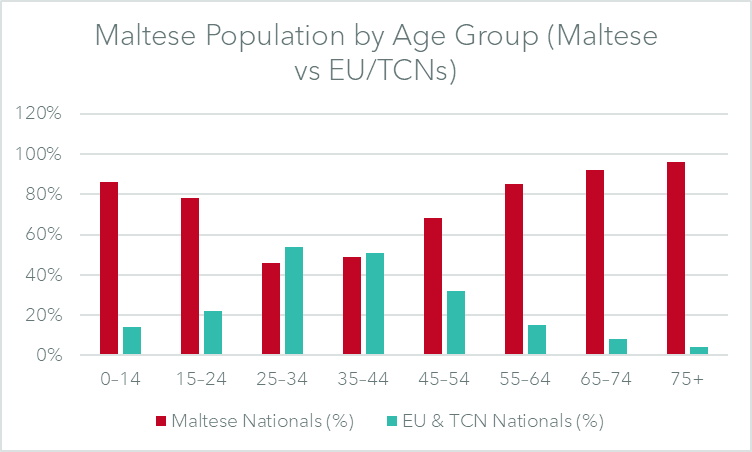
This morning I attended an economic analysis conference. One of the data points presented is the below. As can be seen below, by end 2024, Malta’s population had the age cohorts between 25 years to 44 years, which had more EU & TCNs than Maltese nationals in these age cohorts.
What does this mean for family businesses?
It means that the demographic reality of Malta has reached a historic tipping point. As the data suggests, in the core working-age group of 25–44, foreign nationals (EU and TCNs) now outnumber Maltese citizens.
This is no longer just a “migration topic”; it is the defining challenge for the Maltese economy. For family businesses—the backbone of the local economy—this shift signals that the era of “growth through hiring” is coming to an end.
Malta is currently caught in a tight labour market paradox. While the economy continues to expand, the “native” labour supply is shrinking and aging. We have made up for this by getting foreign labour, which has now led to have a foreign majority in what is considered the work force engine of the economy i.e. between ages 25 to 44 years. Add to this the reality outline by recent data from the Central Bank of Malta showing that nearly one-third of foreign workers leave within their first year.
The message for business, including family business is clear. Relying on a constant stream of new employees is becoming prohibitively expensive due to rising recruitment fees, administrative delays in TCN permits, and the rapid upward pressure on wages.
For many Maltese businesses, the traditional reaction to growing the business work is to employ more people. However, as outlined above this strategy is hitting a wall.
If your business growth is tied 1:1 to your headcount, your growth is currently capped by the availability of workers. Thus the need for Digitalisation. Digitalisation allows for decoupled growth—where revenue can increase without a corresponding increase in the number of employees.
Family businesses often hesitate to invest in high-end software or automation due to the initial capital outlay. However, when compared to the long-term cost of recruiting, training, and eventually replacing a TCN every 24 months, automation pays for itself rapidly. Moreover, when you remove “drudge work” through technology, the roles you do hire for become more skilled and interesting, leading to better retention of both Maltese and foreign talent.
The data is clear. The “Maltese” workforce is simply not large enough to sustain current business models and Malta cannot keep getting increasing number of foreign workers indefinitely. Every business needs to urgently and seriously undergo a digital transformation strategy based on the below points:
- Identify and map every process in your business, especially those that are repetitive and “manual.” These are your biggest risks in a tight labour market. This would be the first step in identifying the efficiency gains that any investment in digital solutions can deliver.
- Upskill, don’t just Recruit: Instead of looking for new employees, invest in training your current loyal staff to manage new digital tools.
- Utilise funding schemes to offset digital investments costs.
The goal for any family business today, should not be growth, but sustainable growth. In a country with limited physical space and a finite labour pool, digital transformation is the only sustainable exit from the present tight labour market situation.
 A Business Blog for SMEs & Family Businesses