
For over a decade, the Maltese economy has operated under an expansionary model fuelled by rapid population growth and intense domestic demand. For local family businesses, this climate created an operating environment where increasing turnover appeared almost inevitable. However, juxtaposing the recently published Central Bank of Malta’s analysis of the EUROPOP2025 demographic outlook with the findings 2026 Family Business Survey results, which will be presented at the Family Business Conference on the 1st October, reveals that the macro tailwinds that buoyed top-line expansion are slowing down, leaving unguided businesses increasingly vulnerable to severe margin erosion.
The demographic analysis from the Central Bank marks a defining inflection point for the Maltese islands. After successive vintages that continually revised population figures upwards, the latest long-term baseline projections represent the first meaningful downward adjustment. Net migration flows are projected to decelerate over the projection horizon, while Malta’s fertility rate has fallen to the lowest level across the European Union. With mortality climbing alongside an aging population, the projected demographic path is set to cross below earlier forecasts around 2037, signaling a fundamental shift in domestic market expansion. The old-age dependency ratio is consequently projected to rise dramatically over the coming decades, confirming that domestic labor scarcity and wage pressures will remain structurally entrenched rather than temporary bottlenecks.
The ground-level reality captured by the Family Business Survey illustrates the immediate friction caused by these macroeconomic forces. In the post-pandemic period, the overwhelming majority of family enterprises managed to expand their turnover, yet more than half suffered from stagnant or falling profits. This profitless growth stems directly from the ongoing labor squeeze. Business leaders identify staff retention and the recruitment of skilled personnel as their single greatest operational headache, while acknowledging that payroll obligations have inflated faster than their top-line revenues. In an economy where population growth is tapering and the workforce is tightening, relying purely on headcount-heavy expansion without major productivity gains inevitably compresses operating margins.
This margin compression is aggravated by a classic managerial dilemma. Family enterprise leaders report spending almost all of their working hours trapped in reactive operational firefighting—attending to staffing friction, customer disputes, administrative bottlenecks, and cash collection—leaving virtually no meaningful bandwidth for long-term strategic oversight. A substantial portion of leaders openly admit that while they recognise the critical need for a written strategic plan, the daily operational grind prevents them from ever drafting one. This creates an exhausting, self-reinforcing trap where immediate operational chaos crowds out strategic formulation, which in turn leads to unguided operational drift and diluted earnings. Compounding this domestic vulnerability, most local firms maintain an exclusively local market focus, viewing international expansion as an unlikely path and thereby tying their long-term fortunes entirely to an aging domestic demographic base.
Empirical findings from the survey demonstrate that sustainable profitability is not simply an organic outcome of growing larger or belonging to a favored sector. Instead, firm performance follows a pronounced U-shaped curve, where micro-enterprises and large corporations tend to maintain healthy margins, while mid-sized companies become ensnared in a difficult squeezed middle. These mid-tier firms frequently outgrow direct founder oversight but fail to implement the formal governance and systems required to generate true economies of scale. While independent non-executive directors on boards act as vital stabilizers that shield organizations from steep profit declines during high-cost cycles, governance alone cannot compensate for commercial inertia.
Ultimately, the primary actionable enabler that protects operating margins is a formal, regularly reviewed strategic roadmap. Family firms operating with an active strategic plan demonstrate far greater resilience, effectively curbing profit erosion and converting commercial activity into genuine bottom-line gains. As the Central Bank’s demographic projections confirm that the phase of automatic market growth driven by sheer population volume is waning, family business leaders must break free from operational firefighting. Sustainable profitability in a maturing economic landscape will require deliberate strategic direction, digital productivity, and disciplined managerial focus rather than passive reliance on domestic momentum.
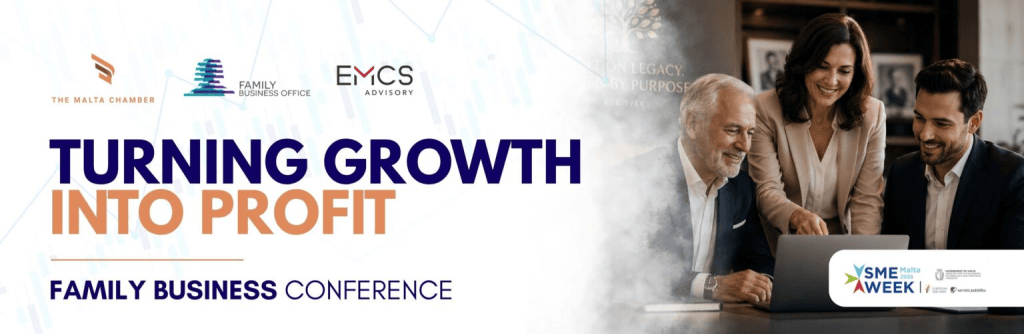
These critical dynamics will take centre stage at the upcoming Family Business Conference, themed “Turning Growth into Profit: Structure, Governance & Digitalisation in Family Business”, co-organised by The Malta Chamber, EMCS Advisory, and the Family Business Office. With demographic expansion decelerating and domestic market dynamics shifting, family business leaders can no longer rely on sheer momentum to carry their bottom line. Attending this landmark conference is essential for founders, directors, and successors seeking to break free from reactive operational firefighting. The event delivers practical blueprints on structuring robust governance, adopting digital productivity solutions, and embedding formal strategic planning to safeguard margins and ensure enduring multi-generational resilience.

